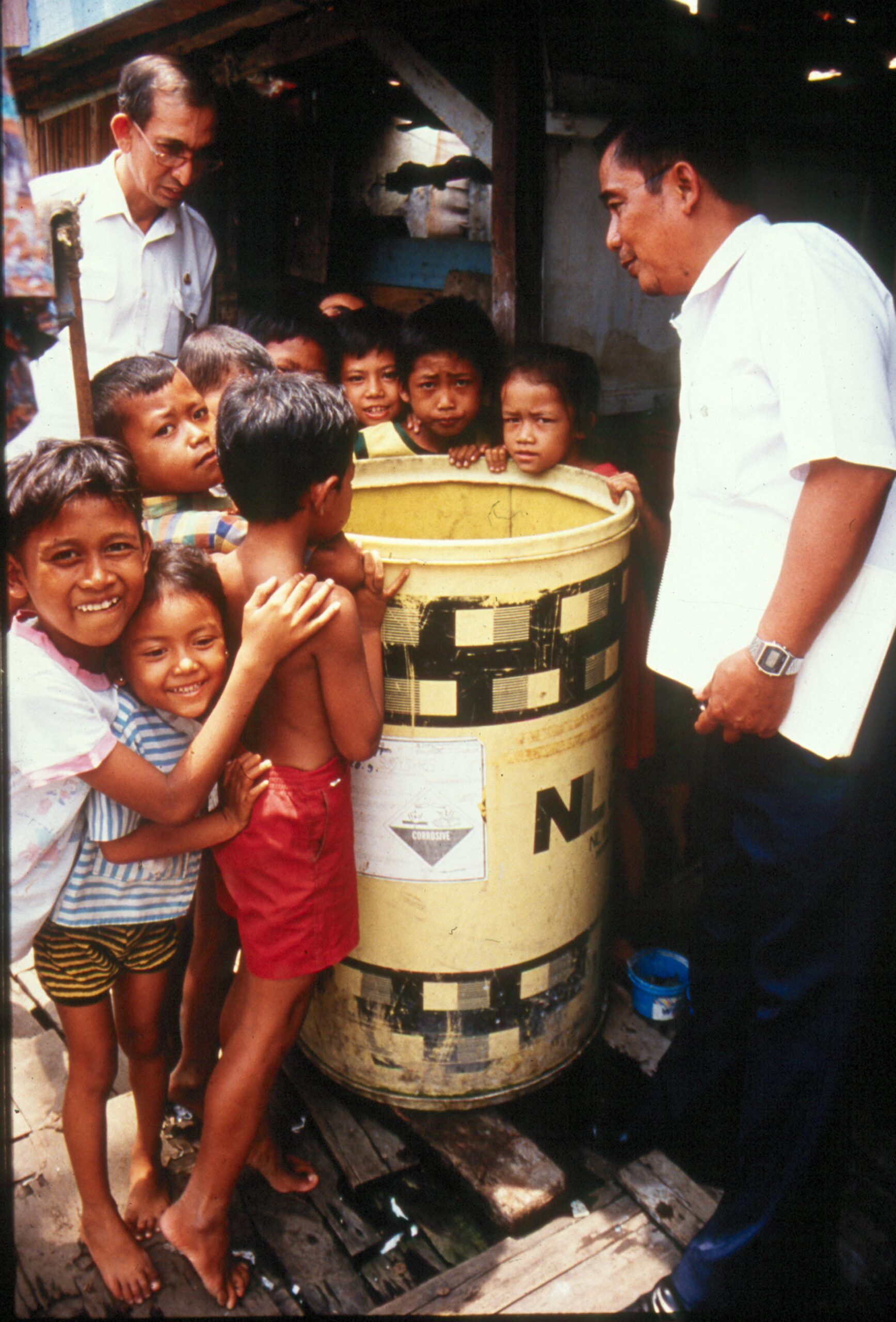
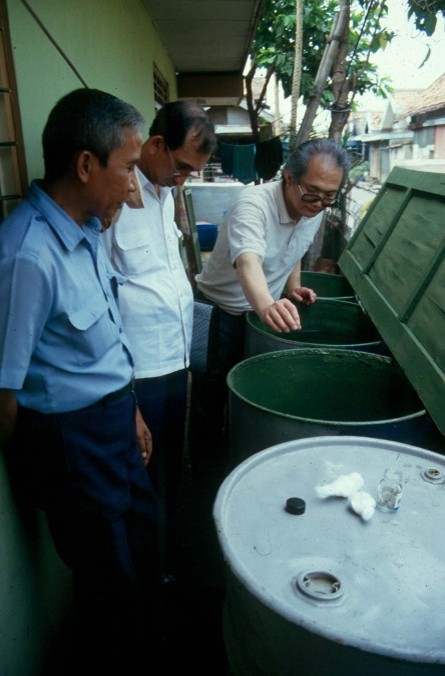
In the early 1990s, in cooperation with KABS, a Bti effervescent tablet was developed in Jakarta for the biological control of dengue-transmitting mosquitoes and successfully introduced.
Indonesia (Jakarta)
In the 1990s, dengue and DHF cases increased significantly in Jakarta. Dengue viruses are transmitted by the main vector Aedes aegypti, which breeds primarily in artificial water containers such as barrels. At the request of the Governor of Jakarta, Wiyogo Atmodarminto, GFS—on behalf of the Municipal Action Group for Mosquito Control (KABS)—was asked to support the implementation of biological mosquito control in Java, Indonesia. Previously, control relied on fogging with malathion, which is also toxic to humans.
An agreement was reached to develop a formulation specifically targeting container-breeding mosquitoes. With the support of the Institute of Dipterology (IfD), a Bti effervescent tablet was developed, presented at a press conference in Jakarta in 1993, and subsequently brought into practical use. Since then, the effervescent tablet has also been widely used in Germany, for example by KABS. This project demonstrates how international cooperation can significantly improve mosquito control both locally and beyond.
Efficacy of a new tablet formulation of an asporogenous strain of Bacillus thuringiensis israelensis against larvae of Aedes aegypti. Bull. Soc. Vector Ecol. 16(1):176-182.
Becker N, Djakaria S, Kaiser A, Zulhasril O & Ludwig H · 1991